This specific guide is built from published industry data and FeedBuzzard’s public site content, not a documented ad campaign — worth knowing upfront, since no one covering this platform has published verified first-party results yet.
Quick Summary
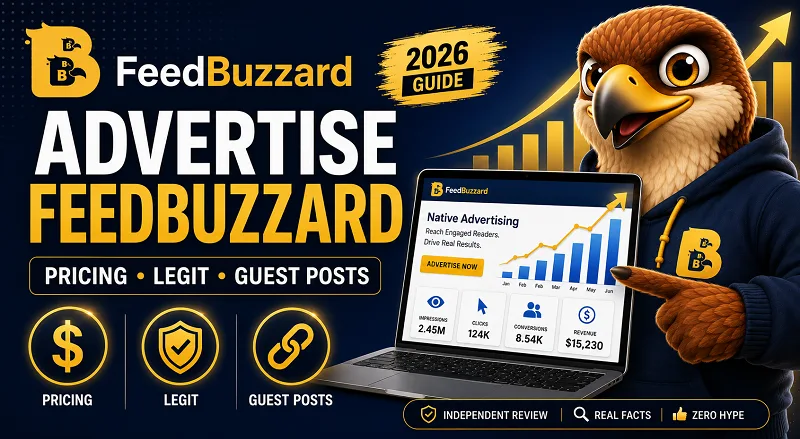
FeedBuzzard (feedbuzzard.com) sells direct-buy native advertising placements — sponsored articles, native feed ads, display banners, and newsletter slots — inside a technology-focused content feed. There’s no published rate card; verified industry sources put native CPM around $5–$15, with native CTR (click-through rate) estimates ranging from roughly 0.2% to 3% depending on methodology. Public listings also show FeedBuzzard sold as a guest-post/backlink product through SEO resellers, separate from any native-ad offering. Best fit: SaaS, apps, and digital-first brands. Weakest fit: offline, local-only businesses.
FeedBuzzard Is Also Sold as a Guest-Post and Backlink Site
FeedBuzzard is independently marketed by SEO resellers as a guest-posting and backlink placement — listings advertise sponsored guest posts and homepage banner links (reportedly around $179, citing a Domain Authority near 56, with dofollow links) through third-party SEO marketplaces, separate from any advertiser-facing native ad product. This doesn’t make FeedBuzzard illegitimate — guest posts are a normal SEO/link-building tactic — but it does mean the site’s traffic and domain authority may be shaped as much by SEO-driven guest content as organic readership. If you want native ad reach and clicks rather than a backlink for search rankings, clarify directly with FeedBuzzard which product you’re buying; pricing and delivery differ between the two.
What Is FeedBuzzard?
FeedBuzzard runs a scrolling feed of articles, trending topics, and recommended reads focused on technology and digital tools. Advertising here is a direct buy, not programmatic bidding — sponsored content is negotiated and placed manually rather than auctioned through an ad exchange. Unlike a demand-side platform (DSP) or self-serve ad network, there’s no automated bidding layer, real-time auction, or audience-targeting algorithm between advertiser and publisher.
FeedBuzzard vs. Taboola, Outbrain, and Other Native Ad Networks
| Platform | Avg. native CTR | Avg. CPM | Self-serve? | Buying model |
|---|---|---|---|---|
| FeedBuzzard | Unpublished — confirm directly | Unpublished — confirm directly | No | Direct buy |
| Taboola / Outbrain | ~0.20% | Varies by inventory | Yes | Programmatic + direct |
| MGID | ~0.15%–0.25% | $3–$8 | Yes | Programmatic + direct |
| Revcontent | ~0.10%–0.20% | $2–$6 | Yes | Programmatic |
| Google Display Network | ~0.046% | ~$3.12 | Yes | Programmatic |
Sources: Display Advertising Benchmarks 2026, Digital Applied and Programmatic Advertising Statistics 2026, Searchlab. MGID and Revcontent figures are general native-CPM industry ranges, not each network’s own published rate card — confirm directly before budgeting.
Taboola and Outbrain offer far greater scale and self-serve control via their own demand-side platforms. MGID and Revcontent sit closer to FeedBuzzard’s size and suit advertisers who want more self-serve control without needing Taboola/Outbrain-level reach.
FeedBuzzard Ad Formats
|
Format |
Best For |
How It Works |
|---|---|---|
| Sponsored Articles | Long-term SEO value, organic traffic | Full write-up, marked as paid, can keep ranking after the campaign ends |
| Native Feed Ads | Low-friction visibility | Short cards styled to match the feed |
| Display Banners | Fast, cheap brand awareness | Traditional image ads in header, sidebar, or footer |
| Newsletter Placements | Reaching an already-engaged list | Ad inside FeedBuzzard’s newsletter, if one exists |
Real Industry Pricing and Performance Benchmarks
These figures come from published, checked native-advertising industry sources — not FeedBuzzard’s own reported numbers:
- Native ad CTR varies by source: Digital Applied puts it around 1.16% versus 0.46% for standard display; LinkJolt cites a broader 0.5%–3% range. A commonly repeated industry shorthand is “0.2%–0.5%, or 4–10x standard display.” Treat all of these as directional.
- Native CPM on curated publisher inventory typically runs $5–$15.
- Viewability: native inventory clears roughly 81% versus 64% for standard desktop display (industry-wide average, not FeedBuzzard-specific).
- Ad fatigue: refresh static creative roughly every 2–4 weeks to avoid declining CTR.
- Mobile share: mobile carries a large, growing majority of display impressions industry-wide; check current figures rather than treating any fixed percentage as static.
How to Advertise on FeedBuzzard: Step-by-Step
- Check audience fit. SaaS, apps, and online tools match this readership well; offline-only businesses generally won’t see the same return.
- Go to feedbuzzard.com directly for the advertise/contact page. Since third-party resellers already market placements here, confirm you’re dealing with FeedBuzzard’s own team, not a reseller.
- Pick one campaign goal — traffic, leads, or sales — instead of optimizing for all three.
- Request everything in one message: traffic estimates, available formats, a sample sponsored post, exact pricing, minimum spend, contract length, cancellation terms.
- Cross-check traffic against SimilarWeb rather than trusting a quoted figure at face value.
- Ask about the approval process — turnaround time and what happens if your first draft is rejected.
- Ask about geographic and device-level targeting — don’t assume parity with a programmatic platform.
- Start with a small test — one week or one month, not a long-term commitment.
- Add UTM parameters (?utm_source=feedbuzzard&utm_medium=native&utm_campaign=test1) to your landing page for clean attribution in your analytics platform.
- Match your landing page to the ad’s exact promise — the fastest way to burn a test budget is a mismatch here.
What a Sample Sponsored Content Request Should Include
Product name and URL, target audience, preferred format, a rough budget range, and a direct request to see one existing sponsored post as a quality sample.
Approval Process and Common Rejection Reasons
Direct-buy platforms typically run an editorial review before publishing, with turnaround commonly between 24 hours and a few business days. Common rejection reasons at comparable publishers: a missing or unclear “sponsored” disclosure, unsubstantiated claims, low content quality, or a mismatch between the ad and the linked page. Ask upfront whether a rejected draft gets a revision window or must be resubmitted from scratch.
Contract and Commitment Norms
Contract duration, minimum spend, and cancellation notice aren’t publicly documented for FeedBuzzard. Comparable direct-buy platforms commonly structure deals as:
- Minimum test period: 1 week to 1 month
- Standard initial commitment: 1–3 months once a test performs
- Cancellation notice: typically 7–14 days
These are industry norms, not confirmed FeedBuzzard terms — get each one in writing before paying.
A Worked Example (Hypothetical Math, Not a FeedBuzzard Result)
A modeled $500 budget at a $10 CPM and 0.3% CTR generates roughly 50,000 impressions and 150 clicks. At a 5% landing-page conversion rate, that’s 7–8 conversions — useful for estimating cost-per-lead before scaling. This is arithmetic built on industry benchmarks applied to a made-up budget; it says nothing about what FeedBuzzard itself will deliver.
Pros and Cons
Pros:
- Native format outperforms standard display on viewability (see benchmarks above)
- Sponsored articles can keep ranking and driving organic traffic after the campaign ends
- Tighter niche relevance for tech/SaaS audiences than a broad programmatic buy
Cons:
- No published rate card, contract terms, or verified traffic
- No self-serve dashboard, unlike Taboola, Outbrain, MGID, or Revcontent
- Also sold as a guest-post/backlink-reseller product, which requires clarifying what you’re actually buying
- Weak fit for offline, local-only businesses
Advertiser Checklist Before You Pay
- Current traffic estimate confirmed directly and cross-checked against SimilarWeb
- Clarified whether you’re buying a native ad placement or a guest-post/backlink product
- Exact pricing in writing (CPM, CPC, or flat fee)
- Contract length, minimum spend, and cancellation notice in writing
- Geographic and device-level targeting availability confirmed
- Sample sponsored post requested
- Approval turnaround and revision/appeal policy clarified
- UTM tracking set up before launch
- “Sponsored” disclosure requirement and content guidelines confirmed
- Test budget (one week or one month) rather than a long-term commitment
Key Takeaways
- FeedBuzzard sells native advertising as a direct buy, not through programmatic bidding.
- No FeedBuzzard-specific pricing, traffic, or CTR/CPM data is independently verified; benchmarks here reflect the broader market, not the platform itself.
- Public listings show FeedBuzzard also sold as a guest-post/backlink product, separate from native ads.
- Best fit: SaaS, apps, digital-first brands. Weakest fit: offline, local-only businesses.
- Closest alternatives: Taboola, Outbrain (scale), MGID, Revcontent (comparable size), Google Display Network (programmatic).
- Start with a small, UTM-tracked test before committing longer-term.
Frequently Asked Questions
Is FeedBuzzard legit? No independent data confirms FeedBuzzard’s traffic or ad performance, and it’s also sold as a guest-post/backlink product. That doesn’t make it illegitimate — verify traffic, request a sample post, and get terms in writing before paying.
What is FeedBuzzard advertising? Native ads, sponsored articles, or banners placed inside FeedBuzzard’s content feed, sold as a direct buy rather than automated bidding.
How much does it cost to advertise on FeedBuzzard? Unpublished. Verified industry-wide native CPM benchmarks run $5–$15. Guest-post/backlink placements are listed separately around $179 through resellers — a different product.
What are the best FeedBuzzard alternatives? Taboola and Outbrain for scale and self-serve setup; MGID and Revcontent for a size closer to FeedBuzzard; Google Display Network if native format isn’t required.
How long does FeedBuzzard’s ad approval take? Not publicly documented. Comparable direct-buy publishers typically take 24 hours to a few business days.
How do I track FeedBuzzard ad performance? UTM-tagged landing page URLs plus your analytics platform, isolating FeedBuzzard’s traffic and conversions from other channels.
Who should advertise on FeedBuzzard? SaaS, apps, and digital-first brands whose audience already reads tech and online-tool content.
Conclusion
FeedBuzzard’s native format addresses a real weakness in standard display advertising — banner blindness — and its audience skews toward readers already primed to care about a digital product. What it doesn’t offer publicly is verified pricing, contract terms, or performance data, and it’s also marketed as a guest-post/backlink placement service alongside any native-ad offering — which puts due diligence squarely on the advertiser. Treat a first campaign as a small, tracked test: confirm every number and product detail in writing using the checklist above, tag your traffic, and measure against the benchmarks in this guide rather than assumptions.