Picking the right digital tool shouldn’t take longer than the task it’s meant to solve. This tool guide zardgadjets breaks down the main categories worth knowing. It also gives you a practical way to evaluate any tool before committing to it — and flags the mistakes that quietly waste the most time. Whether you’re a student, a small business owner, or just tired of juggling five apps that do the same thing, the goal here is simple: fewer tools, better fit.
A Quick Note on “Zardgadjets”
If you’ve landed here expecting a single official app or platform called Zardgadjets, it’s worth being upfront: there isn’t one. The name shows up across several independent guides online, each describing something different — one calls it a DIY resource, another an all-in-one productivity hub, another an eSports gear site. That’s a sign the term doesn’t point to one real product. Rather than guess or repeat unverified claims, this guide focuses on what’s actually useful: real, well-established tools and a practical way to choose between them.
Why the Right Digital Tools Matter
The tool you choose shapes how much time a task actually takes. A well-matched tool trims steps out of a workflow. A poorly-matched one adds them back in — usually disguised as “just one more setting to configure.” Multiply that across a week of work, school, or running a business, and the difference between a good tool choice and a bad one stops being trivial. Communication stays clearer, repetitive work gets automated instead of repeated, and information that used to take an afternoon to track down is a search away. None of that requires the newest tool on the market — it requires the right one for the job at hand.
Categories of Digital Tools You Should Know
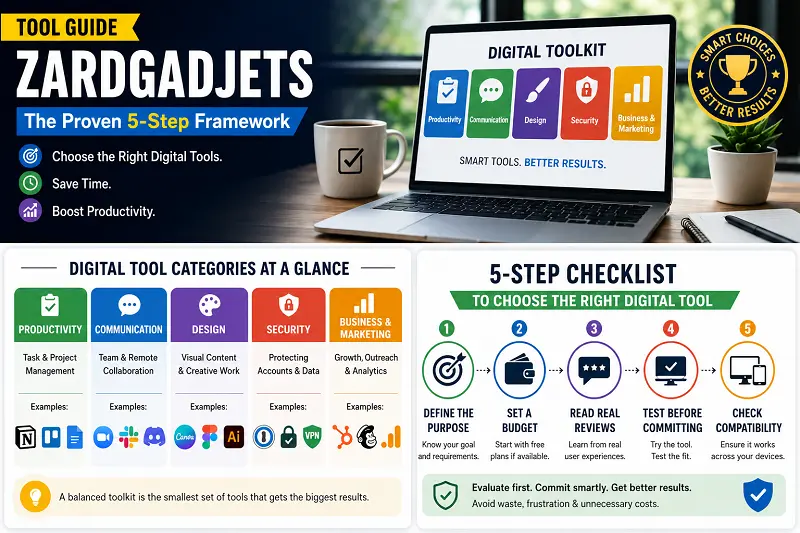
Most tools people rely on daily fall into a handful of categories. Knowing them makes it easier to figure out what you’re actually shopping for.
|
Category |
Best For |
Example Tools |
|---|---|---|
| Productivity | Task and project management | Notion, Trello, Google Docs |
| Communication | Team and remote collaboration | Zoom, Slack, Discord |
| Design | Visual content and creative work | Canva, Figma, Adobe Creative Cloud |
| Security | Protecting accounts and data | Password managers, VPNs |
| Business & Marketing | Growth, outreach, and analytics | HubSpot, Mailchimp, Google Analytics |
Productivity Tools
These handle scheduling, task tracking, and document collaboration. Notion and Trello are common choices for organizing projects visually, while Google Docs and Microsoft 365 cover real-time document sharing. The common thread is reducing the back-and-forth of tracking who’s doing what.
Communication Tools
Zoom and Google Meet cover video calls; Slack and Microsoft Teams handle day-to-day messaging; Discord has become a default for gaming and informal community chat. The right pick usually comes down to how formal the communication needs to be.
Design Tools
Canva lowers the barrier for quick visual design without a learning curve. Figma is built for collaborative interface design where multiple people need to work on the same file. Adobe’s Creative Cloud apps remain the standard for more advanced, professional-grade design work.
Security Tools
Password managers remove the temptation to reuse weak passwords across accounts, and a VPN adds a layer of protection on public or untrusted networks. Neither is optional in 2026 — both are baseline hygiene for anyone working online regularly, a point reinforced by CISA’s cybersecurity best practices.
Business & Marketing Tools
CRM platforms like HubSpot track customer relationships as a business grows past the point of remembering everyone by name. Email tools like Mailchimp handle outreach at scale, and analytics platforms show whether any of it is actually working.
How to Evaluate and Choose the Right Tool
Most people pick tools by popularity instead of fit, which is how someone ends up paying for three overlapping subscriptions. A short evaluation process avoids that:
- Define the actual purpose. Is this for work, school, or personal use? The answer narrows the field fast.
- Set a budget first, not last. Many strong tools have capable free tiers — start there before assuming you need to pay.
- Read real user reviews, not just the marketing page, for a sense of reliability and common complaints.
- Test it before committing. A free trial reveals more in ten minutes than a feature list does in ten pages.
- Check compatibility across the devices and platforms you actually use daily.
Running a tool through these five checks before adopting it avoids the far more common mistake. That mistake is discovering the fit is wrong only after data, time, or a team’s habits are already built around it.
Common Mistakes When Adopting New Tools
The most frequent mistake isn’t choosing the wrong tool — it’s choosing too many. Stacking multiple apps that overlap in function creates more friction than it removes, because now there’s a decision to make about which one to use for a given task. A few other patterns show up consistently:
- Ignoring privacy settings. Some tools collect more data than the task requires; checking what’s actually being gathered takes a minute and is worth it.
- Skipping updates. Outdated software is a common entry point for security issues that a simple update would have closed.
- Never exploring past the basics. Most tools have features that go unused because nobody looked past the first screen.
Avoiding these isn’t about being cautious for its own sake — it’s about actually getting the value out of a tool instead of just adding it to a pile.
Building a Balanced Toolkit
A balanced toolkit isn’t the biggest one — it’s the smallest one that still covers what’s actually needed. That means each tool earns its place by solving a real problem, tools that overlap get consolidated rather than stacked, and security isn’t an afterthought bolted on later. When a toolkit is built this way, it stays easy to manage even as needs change, instead of growing into something nobody fully understands anymore.
Frequently Asked Questions
What exactly is Zardgadjets? There’s no single verified product or company behind the name — it’s used inconsistently across different sites. This guide treats “Zardgadjets” as the title of the guide itself and focuses on genuinely useful tool categories and selection criteria instead.
What’s the difference between free and paid digital tools? Free tools typically cover core functionality but cap usage, users, or storage. Paid tiers usually add higher limits, advanced features, and dedicated support — worth it once a free plan’s limits start getting in the way of real work.
How many tools should a small team realistically use? There’s no fixed number, but if switching between apps takes noticeably longer than the tasks themselves, that’s a signal to consolidate rather than add another one.
Are free tools safe to use for business tasks? Many are. But it’s worth checking a tool’s privacy policy and data-handling practices before using it for anything sensitive. Free doesn’t automatically mean less secure — it just means it’s worth verifying rather than assuming.
How often should I switch or update my tools? Updates should happen as soon as they’re available, for security reasons. Switching tools entirely is a bigger decision — worth revisiting only when the current setup is actively causing friction, not on a fixed schedule.
What’s the biggest mistake people make when picking new software? Choosing based on popularity rather than actual need, which usually leads to paying for — or learning — features that never get used.
Can one tool work for both personal and professional use? Often, yes — productivity and communication tools especially tend to be flexible enough for both, as long as data from each context stays appropriately separated.
How do I know if a tool is worth paying for? If the free tier’s limits are actively slowing down real work regularly, that’s usually the clearest sign it’s time to upgrade rather than work around it.
Final Thoughts
The right toolkit isn’t the one with the most apps — it’s the one that fits how you actually work. Start small, test before you commit, and let go of anything that stops earning its place. That’s the whole idea behind this tool guide zardgadjets: fewer decisions, better fit, and tools that quietly do their job instead of adding one more thing to manage.