If you searched “connectivity hssgamepad” because your controller won’t pair, keeps dropping mid-game, or connects but won’t respond to button presses, you’re not dealing with a rare problem — these are the three most common wireless-gamepad complaints, and most trace back to one of a handful of causes. This guide walks through fixes in order: battery first, then pairing, then the trickier stuff like input modes and interference.
A note on scope: exact button-hold times, menu labels, and battery-compartment layouts can vary between HSSGamepad models and firmware versions, so treat the specifics below as general Bluetooth/2.4GHz/USB troubleshooting logic, not manufacturer-confirmed specs. Check your unit’s manual for exact numbers where it matters.
How HSSGamepad Connects
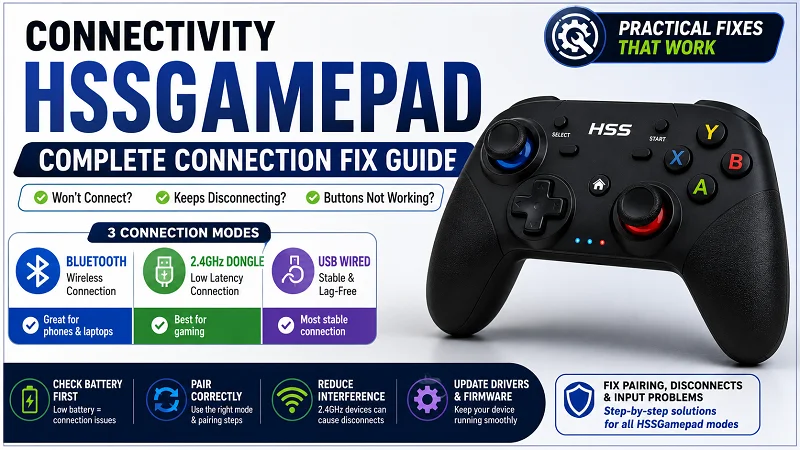
Before troubleshooting anything, confirm which connection mode your HSSGamepad is using, since the fix changes depending on it:
- Bluetooth — wireless, no dongle required, works well with phones and laptops
- 2.4GHz dongle — a small USB receiver, generally lower latency than Bluetooth
- USB wired — a direct cable connection, the most stable and lag-free of the three
A lot of connectivity complaints turn out to be someone troubleshooting the wrong mode entirely — trying Bluetooth fixes when the controller is actually set to 2.4GHz, for instance.
Start With the Battery
A weak battery is a common, often-overlooked cause of HSSGamepad connection failures. As charge gets low, wireless signal strength and responsiveness typically degrade before the controller fully dies — failed pairing attempts, random disconnects, and input lag are common symptoms. Charge the controller fully before troubleshooting anything else; it rules out the most common cause first.
Getting Bluetooth Pairing Right
A common mistake: assuming that simply turning the gamepad on puts it into pairing mode. It usually doesn’t. On an HSSGamepad, the general process looks like this:
- Turn the gamepad completely off
- Hold the pairing button until the LED starts blinking rapidly (check your manual for the exact hold time — it varies by model)
- Open Bluetooth settings on your phone or PC and select the controller from the list
If it doesn’t show up, check whether it’s already paired to another device — most gamepads can only maintain one active Bluetooth connection at a time, so they won’t appear as available elsewhere until you forget or disconnect the old pairing.
HSSGamepad Connects, But Nothing Happens
This is a different problem from not pairing at all. Usually it means your device recognized the controller as a generic input device — sometimes even a keyboard — instead of an actual gamepad. On PC, this can also be a DirectInput vs. XInput mismatch: most modern games expect XInput, while older titles and emulators often want DirectInput. Turn the controller off, pair it fresh, and check your device’s connected-devices list to confirm it’s labeled as a “Gamepad” or “Controller,” not something generic.
Why HSSGamepad Keeps Disconnecting
Three causes show up most often:
Android battery optimization. Android aggressively shuts down background Bluetooth activity to save power, without asking first. Go to Settings → Apps, find your game or Bluetooth service, and set battery optimization to “Unrestricted.” This resolves the “disconnects every few minutes” complaint for a large share of Android users.
Signal interference. Wi-Fi routers, microwaves, and other Bluetooth devices all compete for the same 2.4GHz frequency band. Switching your router to 5GHz where possible noticeably reduces dropouts.
Corrupted pairing data. A saved connection profile can get stale or conflict with something else. Forgetting the device and re-pairing from scratch clears this out more often than you’d expect.
USB and Dongle Troubles
If your HSSGamepad’s wired connection isn’t being recognized, check the cable first — plenty of charging cables carry power but not data. Look for one explicitly labeled as a data cable. On Windows, a “USB Device Not Recognized” error usually means: open Device Manager, uninstall the flagged device, then unplug and replug the controller so the driver reinstalls cleanly.
For 2.4GHz dongle users: check your packaging and manual for where the receiver ships — some store it inside the battery compartment, others include it separately. Plug it directly into a USB port rather than through a hub, and double-check the mode switch is actually set to 2.4GHz — leaving it on Bluetooth by mistake is a common cause of “the dongle isn’t working” complaints.
A Few Habits That Prevent Most Issues
- Turn the gamepad off when you’re done — leaving it on drains the battery and stresses the Bluetooth module over time.
- Avoid switching connection modes mid-session
- Keep firmware and PC drivers reasonably up to date
- Swap out old or worn cables before they become a silent source of intermittent drops
FAQ
Why won’t my HSSGamepad connect at all? Start with the battery — a low charge is the single most common cause. If it’s charged and still won’t pair, confirm you’re in the right connection mode (Bluetooth vs. 2.4GHz vs. wired) before trying anything else.
Why does my HSSGamepad disconnect randomly during play? On Android, background battery optimization is the most frequent cause. On any platform, Wi-Fi or Bluetooth interference from nearby devices is the second most common.
It pairs, but the buttons don’t work — why? Your device likely recognized it as a generic input device rather than a gamepad, or there’s a DirectInput/XInput mismatch. Re-pair from scratch and check how it’s labeled in your connected-devices list.
Is wired or wireless more reliable for HSSGamepad? Wired (USB) removes wireless variables entirely and is the most consistent option when latency or drops matter.
Bottom Line
Most HSSGamepad connectivity issues trace back to software or configuration, not to a broken controller. Getting the battery, pairing mode, and drivers right resolves the overwhelming majority of cases. If you’ve worked through everything here and the problem persists — especially if the LED won’t light up at all, or the connection drops within thirty seconds every single time — that’s a reasonable point to suspect a hardware fault and contact the seller while you’re still within warranty.