
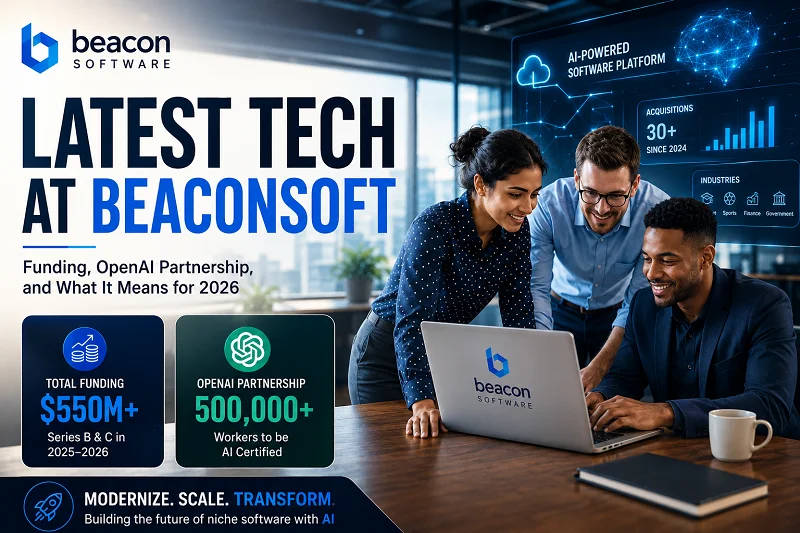
Here’s the latest tech info at BeaconSoft, based on real company announcements and independent reporting. “BeaconSoft” appears to point to Beacon Software (also known simply as Beacon), a venture-funded technology holding company. Beacon buys and modernizes niche software businesses in industries like insurance, youth sports, education, and local government. No official Beacon material spells the name as one word — that shorthand shows up mainly in secondary write-ups. But the details line up closely. The OpenAI partnership, the funding figures, and the acquisition activity all point to Beacon Software as the real-world match for this search.
In 2026, the company raised a $225 million Series C. It also deepened a partnership with OpenAI to certify 500,000 small-business workers in AI skills. And it kept acquiring companies at a pace of roughly one per week. Here’s what each development means. It’s drawn from company statements and independent reporting from Reuters, The Globe and Mail, and BetaKit.
Latest Tech Info at BeaconSoft: What Is Beacon Software, Really?
Beacon was founded in early 2024. Its co-founders are Nilam Ganenthiran, formerly President of Instacart, and Divya Gupta, a former partner at Sequoia Capital. The company’s model isn’t building software from scratch. Instead, it acquires established “vertical market” software businesses. These are small, profitable, founder-led companies serving specific niches, like youth soccer leagues, campgrounds, or concrete manufacturers. Beacon runs them on a shared technology platform.
Ganenthiran has described Beacon as an “anti-private equity firm.” The traditional private-equity playbook is to buy a company, cut costs, and exit within a few years. Beacon says it does the opposite: it intends to hold companies permanently. It reinvests in them and keeps founders on through earn-outs. Reuters reported the company targets firms generating under $20 million in annual recurring revenue. Those firms are typically already profitable, or close to it.
Beacon’s Latest Funding: Series B, Series C, and Who’s Backing It
Beacon closed a $250 million Series B in November 2025. The round valued the company at $1 billion. It also brought total funding to $335 million at the time, according to Reuters. Backers included General Catalyst, Lightspeed, and D1 Capital. Individual investors joined too, including Instacart CEO Chris Rogers and OpenAI CEO Fidji Simo.
Seven months later, in June 2026, Beacon raised a further $225 million in Series C. General Catalyst and HarbourVest led the round. Lightspeed, Intrepid Growth Partners, and several other funds also took part. Industry publication BetaKit reported the round brought Beacon’s total funding to more than $550 million. That makes it one of the best-capitalized companies pursuing this AI-driven roll-up strategy.
| Round | Date | Amount | Lead Investors | Reported Total Funding |
|---|---|---|---|---|
| Series B | November 2025 | $250M | General Catalyst, Lightspeed, D1 Capital | $335M |
| Series C | June 2026 | $225M | General Catalyst, HarbourVest | $550M+ |
Not the Only Player: How Beacon Compares to Constellation Software and Valsoft
Beacon’s strategy isn’t unprecedented. The Globe and Mail has directly compared Beacon to Toronto-based Constellation Software. That company has acquired more than 1,000 small software firms over several decades. Beacon has also been compared to Montreal’s Valsoft Corp, which runs a similar buy-and-hold model.
Beacon’s founders argue their AI layer sets them apart. Rather than mainly consolidating back-office functions, Beacon’s “acceleration team” of engineers rebuilds acquired companies’ technology using AI tooling. Ganenthiran told The Globe and Mail the goal is ambitious: take a business growing at roughly 25%, with 25% margins, and lift it to around 30% and 30% within a year. No outside source has independently verified whether that improvement holds consistently across dozens of acquisitions.
The OpenAI Partnership: AI Certifications for 500,000 Main Street Workers
In February 2026, Beacon announced a partnership with OpenAI. The goal is to offer OpenAI Certifications across its network of portfolio companies. Specifically, Beacon wants to bring AI training and certification to 500,000 workers at small and mid-sized businesses this year. Beacon calls these “Main Street” employers — the kind typically left out of enterprise AI rollouts.
The partnership gives customers and staff across Beacon’s portfolio companies access to structured AI training. That’s a step up from ad hoc tool adoption. Named examples include College Kickstart, Let’s Camp, PowerUp Sports, and MAP Policy Partners. It’s part of a broader pattern. OpenAI’s Partner Network, launched in 2026, has been signing on consulting firms and technology holding companies for exactly this purpose. Capable AI models alone haven’t translated into workplace results for most organizations. Closing that gap is what the network is meant to do.
How Beacon Builds Its Portfolio: The Acquisition Strategy
Beacon’s acquisition pace has visibly accelerated. Reuters reported in November 2025 that the company was buying a new business roughly every two weeks. By June 2026, BetaKit reported the pace had increased to about once per week. BetaKit also reported Beacon had acquired more than 30 businesses since its 2024 launch, spanning education, finance, logistics, and recreation.
Beacon separately reports EBITDA growth of more than 50% across its portfolio over the past year. Unlike the acquisition pace, that figure comes only from the company itself. It hasn’t been corroborated by outside reporting.
One concrete example: Beacon’s 2026 acquisition of E2E Soccer, the software backbone for competitive youth soccer leagues in Canada. The company combined it with an earlier acquisition, PowerUp Sports. Together they form what Beacon calls Canada’s only full-stack soccer technology platform. It’s one instance of a pattern across Beacon’s deals. The company buys a niche but essential piece of software infrastructure, then pairs it with adjacent acquisitions. The result is a fuller platform for that industry.
Where This Fits the Bigger 2026 Tech Picture
Beacon’s bet on AI-assisted modernization lines up with several broader trends this year — trends that outlets like MIT Technology Review have tracked closely — though Beacon hasn’t tied its strategy directly to any of them. Stanford’s 2026 AI Index found that 88% of organizations now use AI in at least one business function. That’s up sharply from prior years. But the same report notes that fewer than 10% of organizations have fully scaled AI in any single business function. Adoption and real impact are two different things.
On the infrastructure side, Gartner forecasts global public cloud spending will exceed $830 billion in 2026. That’s growth of more than 21% year over year, largely driven by AI workloads. On security, Verizon’s 2026 Data Breach Investigations Report found something notable: exploiting software vulnerabilities has overtaken stolen credentials as the most common way attackers get into systems. That’s 31% of breaches, versus 13% for credential abuse.
That last point matters for any company rapidly consolidating and modernizing software used by governments, schools, and first responders. Beacon hasn’t publicly commented on this specific data point, but the relevance stands regardless.
What This Means for Small Businesses and Beacon Customers
If your business uses software from one of Beacon’s portfolio companies, expect more centralized infrastructure and faster feature updates. Through the OpenAI partnership, you should also get access to structured AI training. That beats being left to figure out AI tools alone. Beacon’s stated approach is to keep local branding and relationships intact while upgrading the technology underneath. Day-to-day usage shouldn’t change dramatically overnight.
The open question, as with any fast-moving roll-up, is whether integration keeps pace with acquisition. Growing at roughly one company a week is aggressive. Independent reporting hasn’t yet answered the long-term test: whether the promised centralized platform delivers reliability and security improvements at that speed, across dozens of previously independent codebases.
Latest Tech Info at BeaconSoft: Quick FAQ
What is the latest tech info at BeaconSoft? It centers on Beacon Software’s 2026 activity: a $225 million Series C, a $550 million+ funding total, an OpenAI partnership to train 500,000 small-business workers, and an acquisition pace of roughly one company per week.
Who founded Beacon Software? Nilam Ganenthiran, former President of Instacart, and Divya Gupta, a former partner at Sequoia Capital, founded the company in early 2024.
How much funding has Beacon raised? More than $550 million as of its June 2026 Series C, according to BetaKit, across a Series B ($250M, November 2025) and Series C ($225M, June 2026).
What is Beacon’s partnership with OpenAI? Announced in February 2026, the partnership aims to bring OpenAI Certifications and AI training to 500,000 workers across Beacon’s small-business customer network.
How is Beacon different from Constellation Software? Both buy and hold niche software companies long-term. Beacon’s founders emphasize an added AI layer — rebuilding acquired companies’ technology with AI tooling rather than mainly consolidating operations, as reported by The Globe and Mail.
Is Beacon Software the same as beaconsoft.net? There’s no evidence connecting the two based on available research. Beacon Software is the venture-funded company described in this article. Other sites using similar naming appear to be unrelated. No corporate registry check was performed, so this shouldn’t be treated as a definitive legal conclusion.